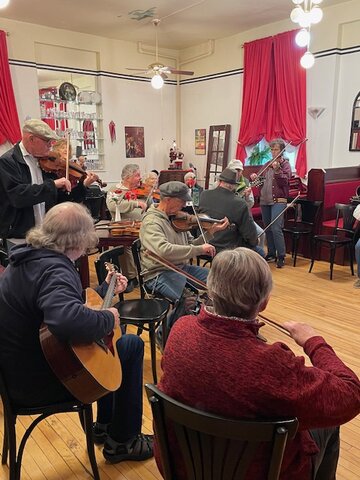
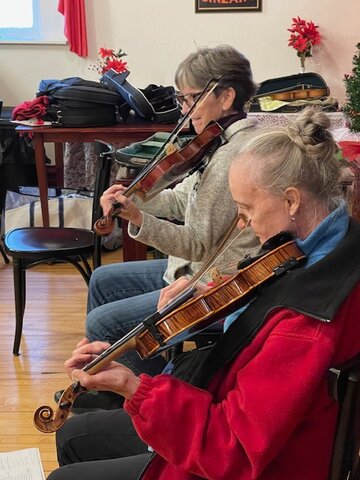
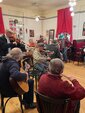
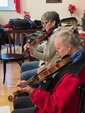
What a treat we’re enjoying once a month at the Museum. Area fiddlers, banjo and guitar players are gathering to jam and make music together and give our two historic museum fiddles a workout so they stay in good condition. This month players came from Wabasha, Lake City, Zumbrota, Wanamingo and other places, too. These are informal jam sessions that you’re welcome to attend. When we know when the fiddlers are coming next, we’ll invite you via Facebook.
It’s said that people clap after a violin piece while people clap during a fiddle number. I know I can’t help but clap when the fiddles are playing. So where did our lively American fiddling tradition come from? It is a gift from our immigrant ancestors.
As they came to America from England, Scotland, Ireland, Germany, Bohemia, Norway, Switzerland, the Netherlands and many other places, a fiddle was a small and easily transportable instrument to bring from the “old country”. How lovely it was to gather with family and friends from the motherland and play and dance to the folk tunes with which they’d all grown up. It was a way of keeping the old traditions alive in America. It was also one of the most popular forms of entertainment in the early days. If country music is your favorite kind of music, it’s the Appalachian fiddlers who came from England, Ireland, and Scotland with their old folk tunes who provided the foundation for country music, along with the influence of African-American banjo players. The first recorded fiddle contest in America was held in Williamsburg, Virginia in 1736. Two fiddlers even accompanied the Lewis and Clark Expedition.
My first introduction to fiddling was reading the Laura Ingalls Wilder books as a child. I loved those books and reading about Pa’s fiddling. His fiddle can be seen today on display at the Wilder Historic Home and Museum in Mansfield, Missouri. One of the fiddles at our Museum is a Sears-Roebuck mail order violin from the early 20th century. It belonged to Margaret Andrist Cooper who grew up in Milton township as part of a very musical Swiss immigrant family. Margaret was even sent to the MacPhail School of Music in Minneapolis to hone her musical skills. Back in Dodge County Margaret taught hundreds of children piano lessons, composed music, and performed. Having no children of her own, Margaret was devoted to the musical studies of her nephew, Sam Ellson, famous in our region for his 60+ years as music director at Berne Church and the guiding force of Swiss Fest. We are grateful to the Eayrs family for the donation of Margaret’s violin. The museum’s other fiddle belonged to David Quackenbush, who founded a music store in West Concord in 1891, when our town was new. It is a quality instrument and we are fortunate to have been gifted it by David’s descendants.
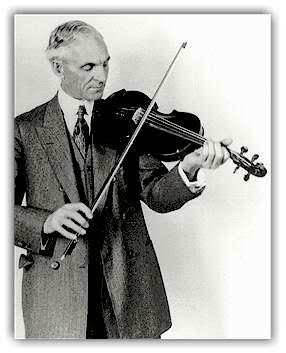
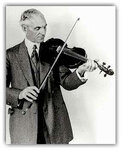
Searching through West Concord Enterprises of the 1920’s and 1930’s, I found that “fiddling” was alive and well in West Concord. That was partly due to the efforts of Henry Ford whose Model T Ford was, as we know, the most popular car of the era. Ford nostalgically looked back on his childhood in rural Michigan with its old-time music and dancing and believed that was what America needed: square dancing, the waltz and the schottische should replace the Charleston and other “modern” dances. To that end he sponsored Fiddle contests at Ford dealerships, collected violins, and helped revive the fiddling tradition.
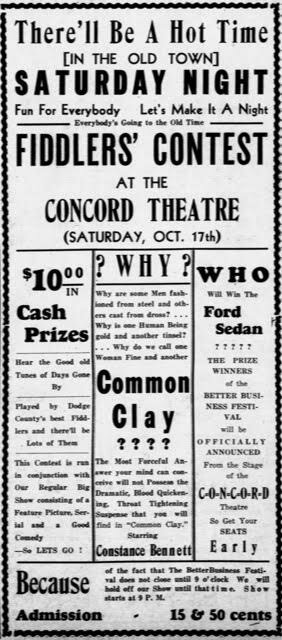
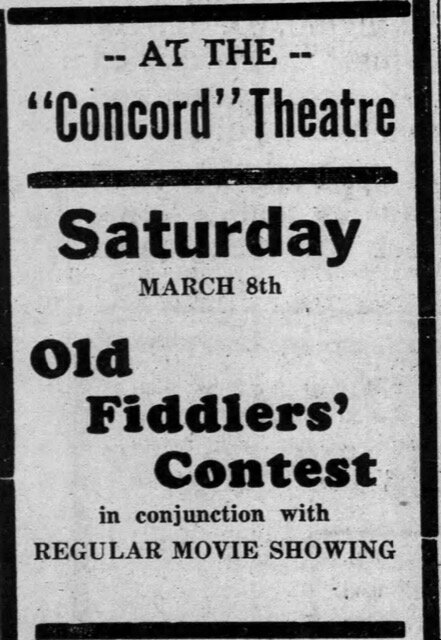
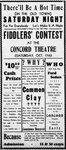
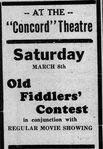
In June of 1927 the Enterprise reported that an Old Time Fiddler’s Contest packed the Opera House. Twenty-two prizes were awarded, from the best rendition of “Turkey in the Straw” to the “Longest Haired Fiddler.” In 1928 the Farm Bureau’s annual 4th of July Picnic featured an Old Fiddlers Contest with the First National Bank supplying the prizes. In March of 1930 A.A. Bryant, Manager of the West Concord Farm Seed Company, sponsored an Old Fiddlers contest at the Concord Theater. The paper reported in its Moland news column that several from Moland attended as one of their residents was performing in the contest. A year and a half later another Old Fiddlers’ Contest was held at the Theater. The newspaper boosted, “It should attract a good crowd.” In 1938 at the Ellington Town Hall, the Dodge County Township officers were treated to a musical program. The last number performed was Andy Wilson dancing a jig, accompanied by Frank Kehoe on the fiddle.
I can’t believe how much fiddling is part of our English vocabulary. Here are a few
fiddling expressions I found when looking at the Enterprises of the 1920’s and 30’s:
“Congress fiddles while Main Street burns”; “Playing second fiddle to too many things
in your life”; “Happier than two fiddles at a wake”; “I’m afraid it’ll bust his fiddle, if it doesn’t break his heart”; “Fiddle away your money”; “When the business fiddles out”;
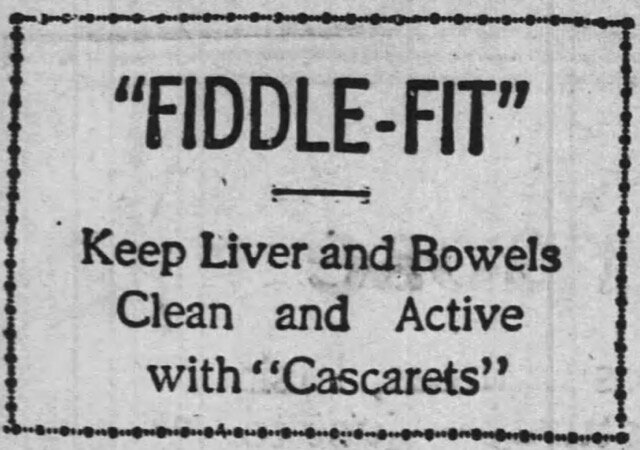
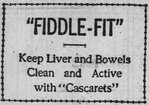
“Fit as a fiddle”; “Life can never be one grand sweet song if your face is as long as a fiddle”; and many more.
As Mark Twain wrote, “We consider that the man who can fiddle all through one of those Virginia reels without losing his grip, may be depended upon in any kind of emergency.” Every summer in July the Minnesota State Fiddle Association hosts a contest and jam close to us at Land’s Lutheran Church in Zumbrota. What a great opportunity for all of us to enjoy the fiddle tradition! In the meantime be sure to watch Facebook for postings about jam sessions at the Museum.