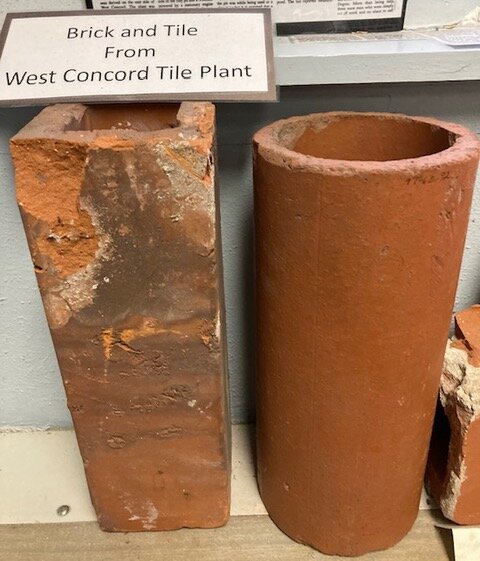
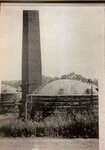
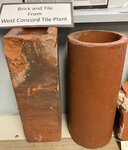
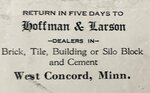
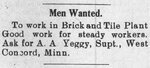
Recently I read a very interesting article about West Concord’s Tile Plant written by Terry Campbell in 2006. It whetted my appetite to want to know more about the Tile Plant’s story. At my home farm we have an old garage built of red brick tiles with hollow centers. I’ve long wondered if the tiles came from West Concord’s Tile Plant. Do you know of buildings in the area made from West Concord brick and tile?
In the early 1900s there was an abundance of brick and tile plants in Minnesota. Blooming Prairie, Rochester, and Zumbrota all had factories. Fires had long been rampant because of the predominance of wood buildings. To make buildings more fireproof it made sense to manufacture brick and tile. The coming of the railroad helped facilitate production and transport of the products. Many localities, like West Concord, were rich in deposits of clay, the raw material needed for production.
The first official word about a tile plant in West Concord came in the April 23rd, 1908 Enterprise with this headline: Our Opportunity, Grand Opportunity for West Concord to Secure Cereal Mill and Tile Factory. A Mr. Swenson and a Mr. Wachtler came to town and spent a week appraising what they saw. They found West Concord’s clay to be as “fine as anywhere in Minnesota” and made the following proposal: they would buy the existing flour mill and convert it to a cereal mill; they would build a tile factory; and they proposed they would operate an electric light plant for the village, but under village ownership. The gentlemen believed that running the three enterprises collectively would make the most economic sense. Their ideas included forming a stock company to finance the Tile Plant. Capital in the amount of $15,000 to $20,000 would be needed and Mr. Swenson and Mr. Wachtler promised to provide half of that amount.
They believed that investors would see a healthy 6 % or more return on their dollars.
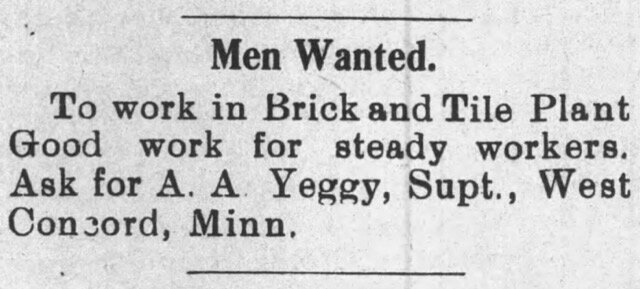
The Village Council appointed two council members to study street lighting for the town and to visit residences and businesses to find out how many people would agree to have electric lights and then the council would meet with the gentlemen to discuss how much operating the electric plant would cost the village. In the meantime Mr. Swenson and Mr. Wachtler left for St. Paul to meet with Great Western Railroad officials to inquire about tunneling under the railroad tracks to get to the bed of clay. The editor of the newspaper encouraged citizens to get behind the project—especially since it was believed that the plant would employ 10 to 25 people. “Support the growth of your city”was the plea.
Six months passed before the Tile Plant project was mentioned again. In November of 1908 the newspaper reported that a test run of 5 tiles and 3 bricks were sent to Albert Lea to be fired in their kiln. If the results were as good as expected the stock company would be formed and the plant built. Three months later The Enterprise announced that the matter was settled. Machines would soon be arriving in railroad cars,12 to 15 people would be hired for the plant, and whatever work could be done in the winter would soon begin. In February the local promoters of the new factory met and organized themselves. Some of their names are familiar to us today: F.E. Mosher, Dell McGowan, W.T. Schmidt, Doc Clifford, Hans Hansen, Ed Bosshard, J.G. McCarthy, and Jake Martig. Machinery had arrived and a kiln and other buildings would soon be erected. Ed Bosshard journeyed to Lehigh, Iowa to look over their brick and the plant.
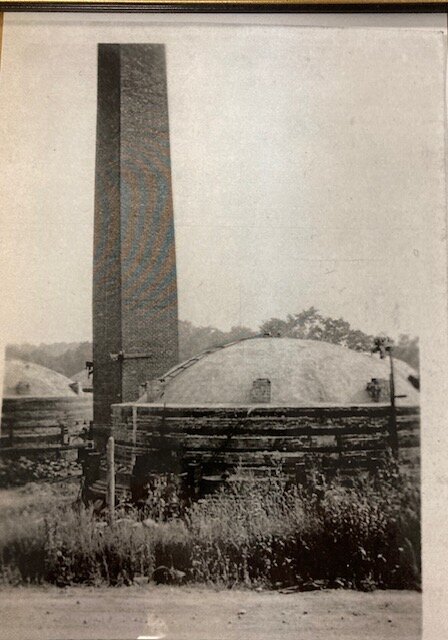
The April 1, 1909 Enterprise reported that there was “good news”. Work on the tile plant had begun. A 28’ x 50’ machine room, a 26’ by 100’ drying shed, and a kiln that was 34’ round and 14’ high were being built. The Chicago and Great Western Railroad had been asked to put in a side track to the factory. It was hoped that clay products could be made by the end of May.
“West Concord Brick and Tile Works to be Enlarged in the Spring” was the headline of the November 11, 1909 Enterprise. Citing that demand for the clay products was greater than supply, plans for the spring were to add a crusher, a granulator, two more kilns, another drying shed, and lay track from the clay pit to the mill so that clay could be carried on railroad cars. The production of hollow blocks along with tile would be the plant’s main focus. They hoped to make three times as much product in 1910.
The editor of the newspaper urged, “Enterprises of this kind mean much to our town, and should be encouraged and helped in every legitimate way by our citizens.” Be a booster was the message.
1910 arrived and the Brick and Tile Plant was thinking about incorporating and increasing its capital stock by almost twice as much as the original outlay. In January the Articles of Incorporation were printed in the newspaper with capital stock of $35,000.
The public was offered $12,000 worth of stock that could be bought in $100 shares.
The improvements at the plant were hoped to allow the production of 20,000 tiles or 40,000 bricks per day. In 1909 the Company’s orders had amounted to 200,000 more tiles than they were able to manufacture.
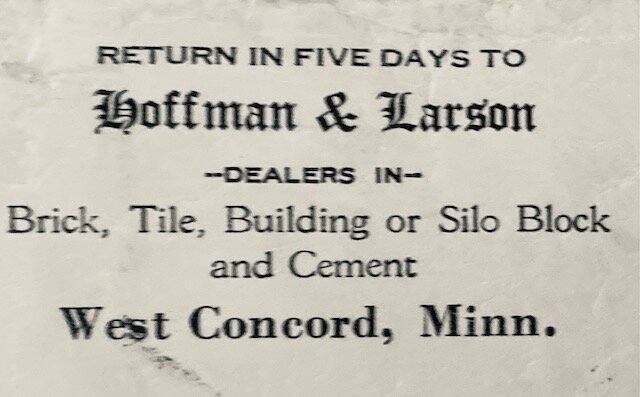
In May 1910 the Enterprise editor promoted the Tile Plant with these words: “Brick and tile manufactured here is equal to any in the country, and we sincerely trust that the people of this locality needing brick or tile will patronize the home concern.
Be loyal to your hometown and encourage this new venture.” Just a few weeks later the newspaper was pleased to report that Ed Smith had bought 30,000 building blocks and F.E. Wright bought many for a new barn. A bit of bragging took place when an order for a railroad car of building block was received on a Friday evening at 8 p.m. and filled and delivered to Dodge Center the next evening. Good management was applauded.
Nothing more was said about the Tile Plant in the Enterprise until December when it
was reported that the Articles of Incorporation had been amended to increase the amount of indebtedness allowed from $5,000 to $15,000. Was this a sign that perhaps things weren’t going very well at the Tile Plant? Not a word was written about the Tile Plant in the 1911 and 1912 newspapers. I’ll leave you wondering until next month about what happened to the Tile Plant. The only clue I’ll give you is that there were at least two more owners in its future.
In the meantime if you know of any buildings that were made from West Concord Brick and Tile, will you let us know at the Museum?